

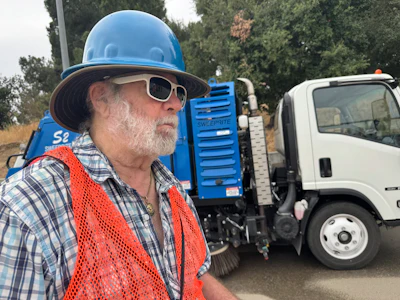
The Pavement Maintenance Hall of Fame exists to recognize more than success. It exists to recognize influence. The effects a person and their career had and continues to have on the work, even if they are no longer actively on the job.
And while some facets of our industry that are more visible and more visibly apparent, like fresh asphalt going down behind a paver or crisp striping snapping a parking lot into order, sweeping has never been that.
Yet, for more than three decades, Ranger Kidwell-Ross, the executive director of the World Sweeping Association, has insisted that sweeping may be one of the most important jobs happening on pavement anywhere in the country, whether anyone is watching or not.
That insistence is why Kidwell-Ross is being inducted into the Pavement Maintenance Hall of Fame in 2026, as well as due to his constant work to further the science, methodology, and excellence within the profession.
A Career Built on Asking an Uncomfortable Question
If there is a single question that defines Kidwell-Ross’ career, it is a deceptively simple one: What happens after the pavement is built?
Long before sustainability became a standard headline or stormwater credits entered everyday industry conversation, Kidwell-Ross understood something most of the pavement world did not want to think about. Pavement is not neutral. What happens on it does not stay on it.
Sweeping, he realized early on the important role that pavement played in regards to our precious water sources.
“I learned that sweeping was really the first line of defense for pavement-based pollutant runoff and clean water,” Kidwell-Ross said. “When I realized that, and I realized that water is going to get more and more scarce, I decided that’s what I wanted to teach.”
That realization became the backbone of a career that blended acts of journalism, education, advocacy, networking and industry building in ways that rarely fit cleanly into one title. Ranger Kidwell-Ross was "all-in."
From Trade Journalism to Trade Advocacy
His entry point into sweeping came through industry communication. While working with Schwartz Industries, he helped produce one of the first dedicated sweeping newsletters, learning the realities of street sweeping and contractor life from the inside.
That exposure did more than familiarize him with equipment or operations. It showed him how fragmented the industry was and how little consistent, accessible education existed for contractors who could not attend trade shows, seminars, or expensive coaching programs.
“I wanted a business that could do something, perhaps for the planet, rather than just be a job,” he said.
That mindset led to the creation of American Sweeper magazine and later WorldSweeper.com, which has now been active for more than two decades. Together, they formed the foundation for what would eventually become the World Sweeping Association (WSA).
The World Sweeping Association was not born out of ambition. It was born out of frustration. It's no secret that he had strong opinions, and a mind to follow his own internal barometer of what was important and what wasn't. So, Kidwell-Ross made a decision that would define the next chapter of his career.
“I decided I’ll just start an association,” he said. “It really bothered me that there was incorrect information being relied on.”
He started the WSA largely on his own, supported by a small advisory group and a commitment to transparency and education that would define the organization’s mission.That commitment was not symbolic.
For years, the association delivered two educational messages per month, published hundreds of articles, conducted more than one hundred contractor interviews, and created practical resources contractors could use in the field and in how they ran their business, from payment disputes to customer education. He also wrote short-form articles printed in every issue of Pavement Maintenane & Reconstruction.
“I wrote updated information, educational information, as best I could all the time,” Kidwell-Ross said. “The idea was to make contractors more professional and answer any kind of questions.”
Now, as he eyes retiremnent, the association houses more than eight hundred articles and exists as one of the most comprehensive sweeping knowledge bases in the world.
Education For The Contractors Who Couldn’t Be In The Room
One of Kidwell-Ross’ most consistent themes is accessibility.
Trade shows, he believes, are invaluable. He's always been a big supporter of contractors gathering together when they can, but not everyone can attend them, and not every contractor has the staff or budget to send multiple people.
“So many people couldn’t go,” he said. “If you can’t, the next step is to read about it. Read an article. Understand what was said.”
That philosophy shaped how information was gathered and shared. Seminar content was recorded when possible. Research was summarized and translated into practical language. The emphasis was always on raising the baseline knowledge of the industry, not creating an insider class of those who "have" access to the best practices and information and those who "have-not."
“Educated contractors are better than ignorant contractors,” he said plainly.
While Kidwell-Ross spent years advocating for sweeping as an environmental tool, validation came through independent research.
Studies conducted in Florida and Minnesota examined multiple methods of removing nitrogen and phosphorus from roadway runoff. Sweeping was not just competitive. It was dominant. That surprised some people, but not Ranger.
“They discovered that sweeping was five-to-seven times more cost-effective per pound to pick up these pollutants,” Kidwell-Ross said. “Why would you do something else?”
That data changed how municipalities began to think about sweeping. In some jurisdictions, sweeping now earns stormwater credits based on material collected, further reinforcing its value within environmental compliance frameworks.
For him, those results were both a relief and motivating.
“That’s now proven,” he said. “And that’s been very validating to me.”
An Industry That Still Undersells Itself
Despite the data, Kidwell-Ross believes sweeping remains undervalued, even within pavement maintenance circles. Too often, sweepers are treated as support equipment rather than essential infrastructure tools. Maintenance is deferred. Technology adoption lags. Unified messaging is absent.
One of his enduring frustrations is the lack of a manufacturers and suppliers association for sweeping.
“We don’t have a unified voice,” he said. “Public works directors and stormwater managers would have a better chance to understand the value if we spoke together.”
He also points to missed opportunities around technology, from vehicle-notification apps to better data tracking, and the industry’s slow movement toward reducing water use in sweeping operations.
“These are solvable problems,” he said. “They just require coordination and will.”
As Kidwell-Ross looks to steps back from day-to-day industry involvement, his legacy is not defined by a single organization or publication. It is defined by an over arching commitment and a message he never stopped repeating.
“Sweeping is the first line of defense for water quality,” he said. “That’s the message I’ve tried to provide.”
He hopes contractors take pride in that role and that municipalities begin to recognize sweeping not as an afterthought, but as one of the most cost-effective environmental investments they can make.
“Sweeping is something you can take a lot of pride in,” he said. “It has all this value, but it hasn’t received the validation it deserves.”
Ranger Kidwell-Ross influenced how sweeping is understood, justified, and defended within the pavement maintenance industry. He built platforms when none existed, challenged assumptions when it was uncomfortable, and stayed focused on education long after it would have been easier to move on.
He did it largely alone, from a home office in the Pacific Northwest, publishing and teaching because he believed the work mattered.
That belief changed the conversation.
And that is why his name belongs in the Hall of Fame.