
Some seal and stripe jobs are defined by square footage, others are defined by pressure. The project that earned this year’s Seal & Stripe: Large Job Award was defined by both. This year's winner won the first ever Superior Striper Award in 2025, and came back this year looking to take home a new prize. The team at G-Force Alabama wasn't dissapointed.
Planning For A Job That Couldn’t Pause
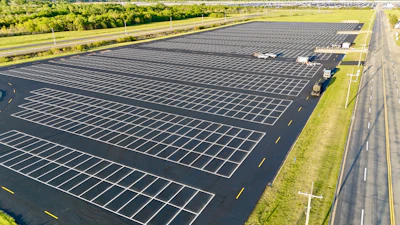
At Hyundai Motor Manufacturing Alabama’s massive manufacturing facility, production does not stop. Cars come off the line. Trucks move continuously. Employees arrive and leave around the clock. Logistics operations run on precision timing. That reality shaped every decision on a sealcoating and striping project that covered 673,000 square feet, required nearly 24 miles of striping, and had to be completed in just five days without disrupting operations.
“There was no downtime,” said Rob Young. “That was never an option.”
From the outset, this project demanded a different mindset than a traditional large commercial lot. Hyundai’s campus is not just big, it is active. Access to loading zones, employee parking, and internal roadways had to be maintained throughout the project.
To make that possible, the team developed a zone-based, phased work plan that allowed sections of the lot to remain open while others were cleaned, sealed, and striped. Each phase was sequenced to maximize curing time while keeping traffic flowing.
“Everything had to be timed,” Young said. “One area curing, another being cleaned, another being striped.”
Daily coordination with Hyundai’s facility, safety, and logistics teams was essential. Morning briefings confirmed closures, reopenings, and traffic flow for the day. Adjustments were made in real time as plant needs shifted.
A Surface That Needed Real Work
Before any sealcoat was applied, the pavement itself presented a major challenge. Years of heavy industrial use had left the lot dusty, dirty, and worn. Layers of dirt and gravel had to be removed before the surface was ready to accept material.
The crew performed multiple mechanical sweeps, working section by section to stay ahead of the sealcoating operation. Cleaning alone became its own production line, with crews moving ahead of the sealcoat rigs to keep the schedule intact.
“We cleaned about 200,000 square feet the first day,” Young said. “Then we sealed that area while cleaning the next.”
Having in-house sweeping equipment was crucial and allowed the team to stay flexible and avoid delays, a critical advantage given the compressed schedule.
The condition of the pavement also meant much of the previous striping was no longer usable as a reference. Faded and worn beyond recognition, the existing markings could not simply be traced or refreshed.
Instead, the team treated the project as a full new layout.
Using aerial imagery, existing plant maps, and field measurements, the layout was rebuilt from scratch. Reference markers were established to ensure alignment across the vast property, maintaining consistency across parking stalls, drive aisles, and internal roadways.
“It wasn’t a [traditional] restripe,” Young said. “It was essentially starting over.”
That level of layout precision was critical on a site with an irregular footprint and constant vehicle movement.
Executing At Industrial Scale
To meet performance and scheduling demands, the team selected SealMaster Coal Tar Ultra, a fast-drying sealer capable of handling heavy vehicle traffic shortly after application. Nearly 17,000 gallons of material were applied using a disciplined, repeatable process.
“We used four tankers,” Young said. “We had a tanker company there every day.”
Sealcoating operations were executed at a pace of roughly 200,000 square feet per day, with two full coats applied. As soon as one zone cured, striping crews moved in behind it.
For striping, the team applied industrial-grade, high-visibility traffic paint using calibrated precision equipment to achieve uniform lines across the entire site. Multiple striping crews worked simultaneously in different areas, coordinated to avoid conflicts and maximize productivity.
The result was a clean, consistent layout spanning nearly twenty-four miles, completed within the five-day window.
Working Inside An Active Manufacturing Environment
Unlike a retail or office complex, the Hyundai facility required constant coordination with on-site logistics. Tractor trailers, employee shuttles, and internal traffic never fully stopped.
Access to critical areas had to be preserved at all times. That meant careful sequencing of closures and reopenings, with no room for missed communication.
“Daily coordination was non-negotiable,” Young said. “Everybody had to know what was happening, every day.”
The team provided daily progress updates and shared layout maps to maintain transparency. When adjustments were needed, they were addressed immediately, keeping trust intact on both sides.
A Relationship Built Over Time
This project did not come to Young in a vacuum. Everything about the project was intentional, and that intentionality is something he and his team apply to everything, not just the field work. Getting this project was the result of a relationship that had been built over multiple years and multiple scopes of work.
The team initially began working with Hyundai on the logistics side of the operation. That work led to additional striping on internal roadways, which Hyundai requests twice a year, particularly ahead of executive visits.
“They want everything looking right,” Young said.
Initially, the Hyundai group wasn't that familiar or that interested in sealcoat as a service for their surfaces. However, after a smaller sealcoating test area was completed the previous year, it proved to be a turning point. After seeing the finish, durability, and minimal disruption, Hyundai moved forward with the full parking lot project.
“They realized it was a long-term investment,” Young said. “It wasn’t just about appearance.”
What stood out to the awards advisory board was not just the size of the project, but the discipline behind it. This was a job where time management, communication, surface preparation, layout accuracy, and material selection all had to align. Any misstep could have impacted production at one of the largest manufacturing facilities in the region.
Instead, the project finished on schedule, with production uninterrupted and the site transformed. Before the work began, the lot was faded and disorganized. Afterward, it reflected the standards of a world-class manufacturing operation: clean, structured, and efficient.
Setting a Benchmark
Large seal and stripe projects often test a contractor’s limits. This one tested everything at once.
By combining strategic planning, real-time coordination, and disciplined execution, the team delivered a result that met Hyundai’s operational demands while setting a new benchmark for large-scale pavement maintenance.
It is that combination of scale, precision, and professionalism that earned this project the Seal & Stripe: Large Job Award, and why it stands as a model for what is possible when preparation meets execution.