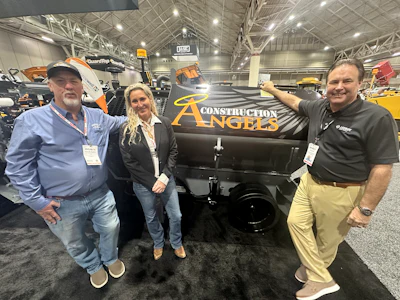
Kristi Ronyak did not set out to run a nonprofit. She set out to run asphalt.
Ronyak is third-generation. Her grandfather started a plant in Burton, Ohio, in 1939. Two brothers, a set of twins, built it into two plants and a paving company. While the business stayed in the hands of family, Ronyak ended up in Florida doing marketing for a concrete cutting company, walking job sites, and, also, watching cars fly past workers at full speed. At the time, she didn't think much of it. It was a normal part of the job. Always had been, always will be.
Then came World of Asphalt 2009. Ronyak recalled an encounter with a woman walking the show floor who was collecting donations for a construction worker's family. It turned out to be for someone who had died on the job. Ronyak immediately made a donation. She assumed the cause had a name, an organization behind it. But to her surprise, it did not.
"I [went] to eight different construction associations, and nobody's raising money for our own industry," Ronyak recalled. She pulled the numbers when she got home. Every day construction workers die on the jobsite in the United States, and since the pandemic, that average has varied between 2-3 workers per day. This news sent her into action, and she started Construction Angels shortly after.
Fifteen years later, the West Palm Beach-based nonprofit provides immediate financial assistance to the families of construction workers killed on the job. The process is intentionally fast. A three-to-five minute form on the organization's website triggers outreach, sometimes before the arrangements are made.
"The sooner we can get that form, the sooner we can provide immediate financial assistance," Ronyak said.
That speed can make all the difference for loved-ones, because the aftermath of a worksite fatality is chaos. OSHA shuts down the job, insurance companies get involved, and multiple legal teams mobilize. A crew that functioned like a family suddenly grieves like one. In that window, a worker's actual family, whether a spouse or partner, children, dependents, can fall through the cracks. Ronyak built Construction Angels with the desire to specifically close that gap.
The Asphalt Industry At The Forefront
Road construction workers represent a disproportionate share of the families Ronyak serves. Two of the most fatal incidents the organization has responded to both involved workers struck by vehicles in active work zones. Six workers died on I-695 in 2023 when speeding vehicles broke through concrete barricades and into a crew. Six more died in Nashville in 2024 -- patch workers on a night shift -- when a vessel struck the Francis Scott Key Bridge while they worked. These cases Ronyak cited in our brief conversation as ones that vividly stuck out to her, but they are merely anecdotal examples of a widespread epidemic.
"The majority of the fatalities that we've helped out the families are from people hitting our workers on the roads," she said.
The organization does not compete with association programs like NAPA Cares or the AGC's similar program. Those programs serve their members well, but importantly, Construction Angels has no membership and, thus, serves everyone. Ronyak frames it as complementary: a family who qualifies for a NAPA scholarship can still apply for a Construction Angels scholarship. Every dollar helps those families who've lost something irreplaceable.
Despite fifteen years of operation and fundraising events in multiple states, awareness gaps persist. Ronyak has even called supporters who attended her golf tournaments, people who wrote checks, only to learn they had suffered a fatality and never submitted a form. This is why awareness is so vital, because help can only reach those who need it, if Construction Angels knows there is a need in the first place.
The answer, consistently, is that companies in crisis do not think about forms. They think about lawyers and shutdowns and the people they lost. That isn't a criticism, just a fact of how their responses normally prioritize what has to be done in the wake of such a tragedy.
Ronyak sees Construction Angels building an infrastructure to fix that. She recently hired additional staff to manage a growing event calendar that routinely schedules simultaneous fundraisers in different states. She credits construction associations as a channel. It helps cooperating with organizations with large member networks that can carry the message further than a single nonprofit can reach alone.
The message is simple. If someone does not come home from your job site, Construction Angels wants to hear from you. Go to constructionangels.org. Fill out the form, and help those in need.