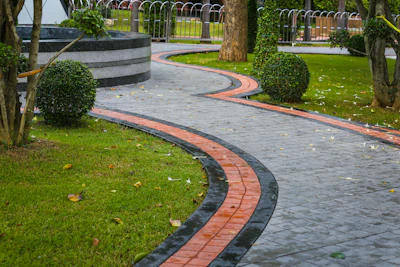
Summer is the time for decorative concrete to shine and for concrete contractors to get busy laying and stamping more elegant designs in sidewalks, patios, driveways, and pool decks. But what happens to the beautiful stone, brick, wood, and other decorative concrete patterns imprinted on the pavement several years later when rain, snow, and multiple freeze-thaw cycles begin to take their toll and promote cracking, deterioration, and ultimately rebar corrosion and further cracking?
Good foresight and preventative maintenance with Migrating Corrosion Inhibitors (MCI) and silane water repellents can go a long way toward enhancing the longevity of textured concrete without changing the decorative appearance.
For Stamped Concrete
Concrete contractors can get clients off to a good start by encouraging the adoption of an MCI admixture into decorative concrete projects that include rebar or wire mesh. These admixtures are typically more budget-friendly than epoxy-coated rebar for corrosion inhibition and can be added to the concrete mix without the set-accelerating effects of calcium nitrite (CNI) admixtures. This is especially critical for crews that need enough time to stamp designs on the concrete surface before it dries. MCI admixtures come in both normal set and set-retarding versions and are known for good workability among ready-mixers.
Routine Maintenance
Once the printed sidewalk or patio is in place, attention shifts to maintenance by facility managers or homeowners. Routine water repellent application is a key part of the process to reduce staining, water ingress, and other deteriorating effects. Corrosion protection for embedded reinforcing metal can be further enhanced by incorporating a dual water repellant/surface applied corrosion inhibitor (SACI). A 100 percent, pure, penetrating, non-film-forming silane water repellent is typically good for use on surfaces where slipping is a concern.
Most, if not all, silanes can be applied to decorative concrete without altering its appearance — a quality that makes them ideal for historical restoration and decorative concrete alike.
 Cortec Corporation
Choosing a Water Repellent for Decorative Concrete
Penetrating silane water repellents work by penetrating the concrete pore structure, chemically reacting with the cementitious substrate to decrease the ingress of corrosives. Water repellents that also contain MCI are intended to supplement this action by forming a protective corrosion-inhibiting layer on embedded reinforcing metal.
In general, application is suggested every seven to 10 years or more frequently as needed.
For surfaces where water repellent has been previously applied, find products that reduce the amount of surface prep needed to remove residue from the previous water repellent application.  Cortec Corporation
Promote Long-Lasting Beauty
Decorative concrete is an excellent way to get the beauty of stone and brickwork without the extra cost and labor of placing individual pavers. One of the tradeoffs is the importance of maintenance, including special protection against moisture ingress, freeze-thaw cycles, and the corrosion that leads to further cracking.
Incorporating an MCI admixture into the ready-mix is a great way to get decorative concrete off to a good start with extra corrosion protection. Routine maintenance can be enhanced by using two-in-one MCI/silane surface treatments.