Most roller-compacted concrete (RCC) paving and dam jobs run into the same problem at procurement: the batching plant gets bought off a ready-mix specification sheet. Someone copies the RFQ from the last concrete plant package, adds a line asking for "RCC capability," and the equipment arrives unable to handle the material it was bought for.
That gap is not a detail. It shows up as blocked mixers, inconsistent Vebe times, cold joints behind the paver, and temperature excursions in mass placements. This column walks through the points that actually change between a ready-mix plant and one built for roller-compacted concrete.
RCC & RMC Are Not the Same Material
RCC is a zero-slump, stiff mixture placed with a paver or dozer and densified by vibratory rollers. It carries a low water content, a high fly-ash fraction, and a coarse, gap-graded aggregate structure. Ready-mixed concrete is plastic, pumpable, and specified by slump. The two look similar in a lab report and behave nothing alike in a batching plant.
 A specification comparison of roller-compacted concrete and ready-mixed concrete.Tongxin Machinery
The Aggregate Size Is the First Specification Line
This is where most RFQs fail. Ready-mix plants are generally built around a maximum aggregate size of 60–80 mm. Hydraulic and heavy-paving RCC commonly runs to 150–180 mm in a four-size blend.
A 150 mm particle does not fit through a standard discharge door, clear a standard mixing arm, or compact evenly under a standard liner plate. The mixer has to be designed for it: modified arm geometry, heavier liners, enlarged discharge opening, and enough installed power to turn a batch that behaves more like gravel than concrete. In some plants, that can mean roughly 20 to 25 percent more motor power than an equivalent-volume commercial mixer, and a longer cycle — typically 60–90 seconds to reach a uniform, fully coated mix, against 30–45 seconds for conventional concrete.
Specify it as a sentence, not an adjective. For example, "Mixer shall accept a four-size blend with a nominal maximum aggregate size of 180 mm, with discharge opening sized accordingly." That sentence prevents six months of argument later.
Powders Multiply & So Do the Scales
Ready-mix usually means cement plus one or two supplementary materials. RCC frequently means cement, fly ash at 30–60 percent of binder, slag, and occasionally silica fume — four streams, sometimes five, feeding one mix design that has to hold a Vebe target within a narrow band.
Every additional powder stream needs its own weigh hopper and feeder with a stable, verifiable feed rate. Specify metering accuracy by stream rather than as a single number: aggregates at plus or minus 2 percent, cement, fly ash, slag, water, and admixture at plus or minus 1 percent. Ask for the calibration report, not the brochure claim.
In our experience, powders that arrive in the wrong order, or too fast into a dry mix, have produced balling and dead spots that only showed up as Vebe drift three hours into the pour.
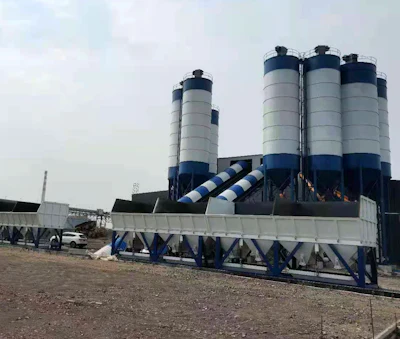
 An aggregate batcher and silo row, seen from the charging side.Tongxin Machinery
Moisture Control Is a Process, Not an Option
Because RCC has almost no free water to spare, a 0.5 percent swing in aggregate moisture moves the mix out of its Vebe window. Online moisture measurement on the fine aggregate, with automatic correction to batch water and a logged record per batch, is the minimum. Manual probe readings between loads are not a control system.
Write one requirement into the specification: an automatic drop-correction routine with a visible alarm for sensor drift. In our experience on dam and highway work, a large share of the RCC quality problems that reach the owner are moisture compensation problems that went unnoticed for a shift.
Temperature Control Has to Be Built In, Not Added Later
Mass RCC placements are temperature-limited. Placement temperatures are commonly capped at about 50 °F (10 °C), with stricter limits down to 44.6 °F (7 °C) where the spec calls for it, depending on the specification, and a plant that cannot chill its own inputs cannot meet that cap in summer conditions.
What to require:
- Aggregate pre-cooling or shading,
- An ice metering system sized to the batch,
- Chilled mixing water, and
- Per-batch temperature logging.
In cold regions, the mirror requirement applies:
- Heated water and
- Frost protection on powder and water lines.
A plant without these provisions rarely gets retrofitted cleanly.
Throughput Has to Match the Paver Train
RCC is a continuous process. The paver moves, the rollers follow, and the plant either keeps up or the job stops. A stoppage longer than the initial set window produces a cold joint that has to be cut out.
The capacity question is not how many cubic meters per hour a plant can make, but whether it can sustain that rate for a full shift without a maintenance window. That drives three items: silo and aggregate stock for a full shift, a mixer line that is redundant or quickly serviceable, and a maintenance schedule that fits the pour plan rather than the vendor's calendar.
In the RCC projects we supply, capacity runs from roughly 150 m³/h
for a road package to well over 400 m³/h where a dam pour dictates the
rate. Matching nameplate capacity to the paver's advance rate — not to the plant's best hour — is the number that keeps the joint clean.
 A mixing tower and aggregate silo group at an RCC batching plant.Tongxin Machinery
What Belongs in the Specification Document
A short checklist for dam, highway, and airport work:
- Nominal maximum aggregate size and the number of aggregate fractions, stated per project mix design.
- Mixer type, installed power relative to batch volume, batch cycle time, and discharge opening dimensions.
- Number of powder weigh hoppers and per-stream accuracy, with calibration records as a submittal.
- Aggregate moisture measurement method, correction logic, and per-batch logging format.
- Temperature control scope: pre-cooling, ice capacity in kg per batch, chilled water, and cold-weather provisions.
- Sustained hourly output with the maintenance plan that supports it, plus stock capacity for a full shift.
- Interface with the compaction QC team: batch records exportable in a format the density testing crew can actually use.
RCC does not fail because the material is difficult. It fails because a plant specified for plastic concrete gets asked to make a stiff, coarse, temperature-sensitive mix under continuous placement pressure.
Writing the aggregate size, the powder streams, the moisture logic, and the temperature scope into the RFQ costs a page and saves a season.